


I’ve just returned from the Davos Communications Summit where nearly every keynote speaker and panel discussed the impact of AI on public relations and communications. This matters because AI is no longer a future capability for PR; it is an immediate test of leadership, skills, and governance.
Today PRWeek has published its UK Top 150 PR Agencies. Over the last month it has been publishing the results of a survey of agencies that made the list. The research reveals that AI skills are now the top investment priority for PR agencies, while a third of agencies describe their investment in AI as ‘significant’.
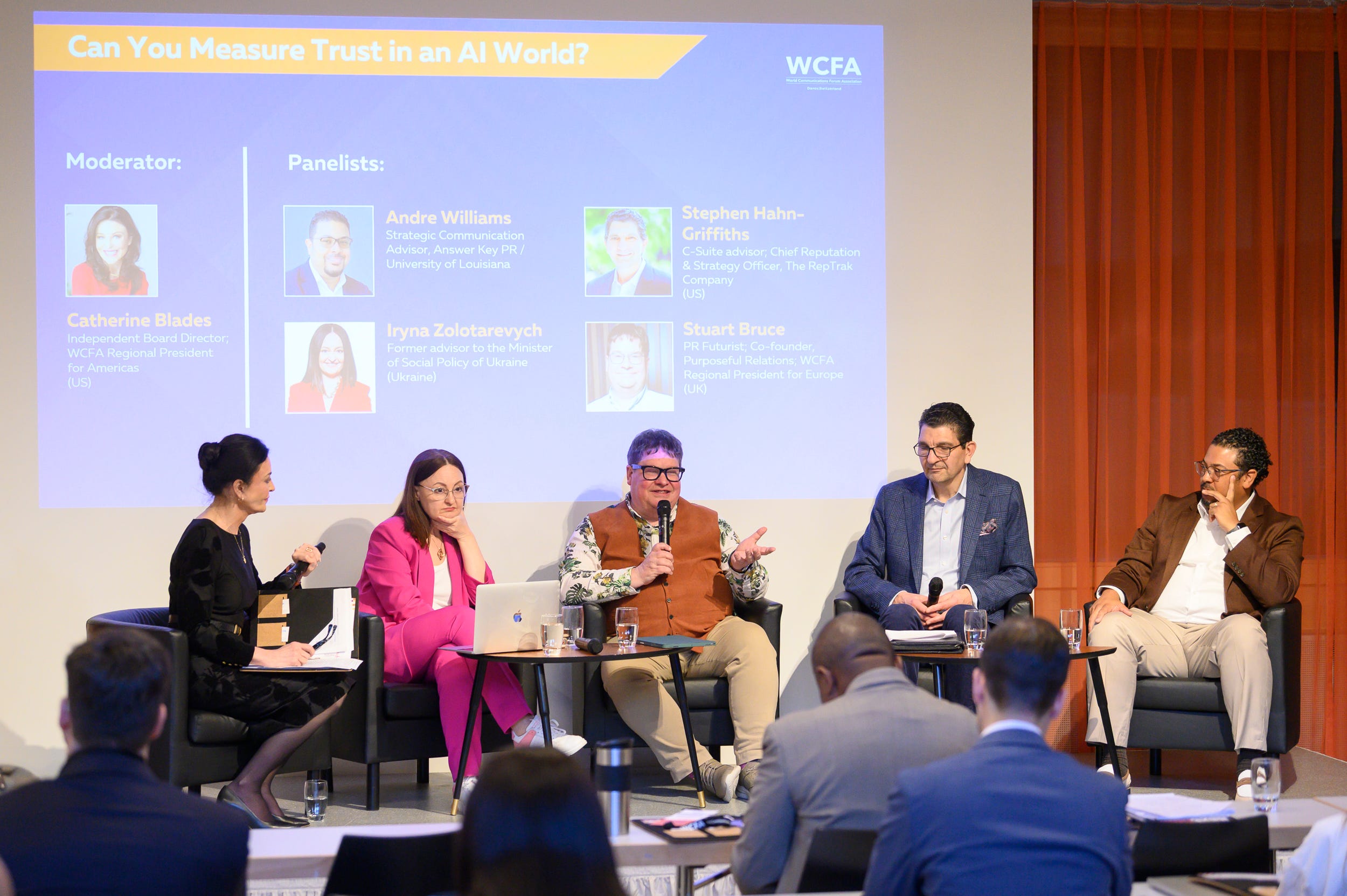
In Davos I participated in a panel, moderated by Catherine Blades, looking at trust in an AI world. My fellow panellists were André Williams (global strategic adviser at Answer Key PR), Iryna Zolotarevych (former comms adviser to the prime minister of Ukraine), Stephen Hahn-Griffiths (chief reputation and strategy officer at RepTrak).
We discussed a wide range of issues with the broad theme being how it is critical for CCOs to get to grips with the reputational risks and impact of AI. Many are still slow to even ensure AI adoption within their teams and aren’t ready for what AI means for their actual communications strategy and plans.
Other news in the issue of PR Futurist include the Singapore foreign minister’s building his own AI ‘second brain’ for diplomacy, Accenture rolling out Copilot to 743,000 users, Microsoft adding agentic features to its main apps, and a top New York law firm caught not checking AI outputs.
AI skills are the top investment priority for PR agencies
New research by PRWeek reveals that AI skills are now the top investment priority for PR agencies. For the first time media relations slips to second place.
PRWeek surveyed its UK Top 150 Consultancies and asked them to rate investment in skills on a scale of zero to five for their top priority.
Artificial intelligence scored an average of 4.3 out of five. Media relations and GEO (generative engine optimisation) tied for second on 3.8.
The important point isn’t the ranking. It’s that AI, media relations and GEO are operationally inseparable in practice. Investing in AI skills means investing in strategy and training for AI adoption across everything teams do. GEO, or treating AI as a stakeholder, is an emerging discipline where media relations skills are critical as earned media is a primary driver of content for AI answers.
PRWeek reveals agency AI spend has surged
The same research reveals that PR agencies are increasing their investment in AI technology and what they are using it for.
A third (33%) of agencies describe their investment in AI as “substantial” with 43% saying it was “moderate”. I’m inclined to treat these claims with caution. We’re still seeing in-house comms teams far more willing to invest in AI adoption than agencies. Our own experience at Purposeful Relations is that the average investment per head by in-house teams in AI training and development is significantly more than most agencies are willing to make.
The top use is research with 91% of respondents using AI for research tasks. It was followed by transcription and/or translation, data analysis, writing copy and creative image presentation.
Do half of PR agencies really do GEO?
An astonishing 54% claim to offer GEO services. I definitely call bull**** on this one as there is a huge difference between claiming to do GEO and actually being able to provide expert consultancy.
Speaking at PRCA NewBizFest on how PR agencies can benefit from GEO
At last week’s PRCA NewBizFest I presented with Tim Bailey on how PR agencies could make the most of GEO opportunities. I made the point that there is a huge difference between buying a shiny new tool, creating a page on a website and adding GEO to a creds deck and actually being able to do it well for clients.
Those PR agencies with the ability to deliver will be a tiny percentage of those claiming to. Some who have made real progress on GEO include Hard Numbers, 72Point (client), The Romans and PR Agency One.
The insights are from PRWeek’s survey of its Top 150 Consultancies.
AI is the new PR and comms stakeholder
I recently did a webinar for Vuelio with Professor Anne Gregory where we discussed how AI impacts public relations and communications far beyond just AI adoption in comms teams. We focused how AI is transforming how practitioners work because it is changing how information is surfaced, interpreted and acted upon.
For communications leaders influencing AI is far more than just simply GEO or generative engine optimisation.
It was moderated by Vuelio’s Phoebe-Jane Boyd who has now published a summary of our discussion and shared the full video. You can read it on Vuelio’s website.
Singapore’s Foreign Minister builds an AI “second brain” to help him with diplomacy questions
Singapore’s Minister for Foreign Affairs, Dr Vivian Balakrishnan, has announced that he has built a ‘second brain’ - a personal AI assistant for a diplomat. He says it answers every question, researches topics, drafts speeches, provides daily briefings, and condenses information on demand.
Dr Balakrishnan said: “It has become invaluable — I don’t dare switch it off!”
He built it himself and runs it on a Raspberry Pi (a tiny low cost computer). On X he explained how he assembled it using existing tools so didn’t even need to vibe code it. He has even used GitHub to publish a full technical explanation of what he did. It is built so that the more questions he asks the smarter it becomes.
Contrast this to Liz Kendall, the UK’s Secretary of State for Science, Innovation and Technology, who said in a recent BBC interview that she didn’t use AI for work! This is in contrast to her predecessor Peter Kyle, who shared how he used AI to help him in the role.
Kendall is a good politician, but she deserved to get a lot more flack and ridicule for this. She has a responsibility to encourage small and medium sized businesses to embrace AI more effectively.
Top New York law firm slammed for incompetent use of AI
Yet another large professional services firm has been caught out using AI incompetently (FT £). This time it is New York law firm Sullivan & Cromwell told a US federal bankruptcy court that a major filing it made in a high-profile case contained multiple “hallucinations” made by AI.
Just like Deloitte before it this isn’t an AI failure, but a human failure. The firm’s partners charge more than $2,000 an hour in bankruptcy cases and earns millions in fees.
The core principle of good governance for AI is human in the loop. Humans must remain accountable for AI outputs and therefore have a responsibility to check it. Something which this highly paid law firm failed to do.
Davos Communications Summit and Awards report

This year’s Davos Communications Summit was a great success with senior communications leaders from 26 countries including Armenia, Austria, Bahamas, Bulgaria, Cameroon, Czechia Israel, Jordan, Nigeria, Singapore, South Africa, Ukraine, United Kingdom, the USA and more.
I was going to do a write up to summarise some of the keynotes and panels, but my friend Iskren Lilov, global marketing manager at Muck Rack, has beaten me to it with this fantastic summary. He’s also included some great photos, not just of the keynotes and summits, but of the amazing scenery we enjoyed in Davos.
Humble brag
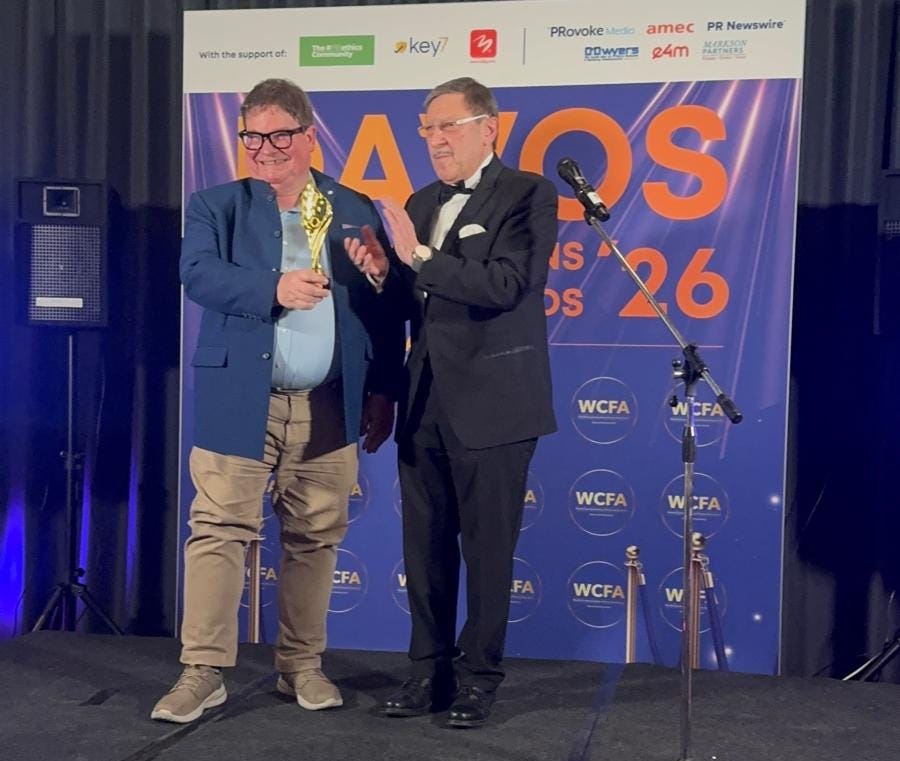
At the Davos Gala Dinner Awards I was honoured to present some of the awards to some very worthy winners. What I hadn’t expected was to be the recipient of an award myself.
I was humbled to receive the World Communications Forum Association (WCFA) President's Award for services to the international communications industry. Traditional British reserves means I fell a little (a lot) uncomfortable about this.
But a conversation with Illka Gobius, CEO of Pinpoint PR in Singapore has made me think a little differently. She told me how before her father passed away he proudly displayed his daughter’s award certificate beside his bed.
Awards aren’t for us, but for the people we serve and the people who love us.
My parents have both passed away but I can picture them now. My Mum proudly telling her many sisters and brothers. My Dad in the local pub enjoying a pint of Ennerdale Wild and boasting to his mates.
I suppose it's not bad for a working class lad from West Cumbria.
WCFA publishes The NextCom magazine
A familiar theme from many speakers at the Davos Communications Summit was the importance of both humans and AI. That’s why I was thrilled to pick up a physical print copy of the new The NextCom magazine. There’s nothing quite compares to the feel (and smell) of print. Articles seem so much more substantial when read from the printed page.
For those of you who weren’t in Davos you can still read the online version of The NextCom magazine.
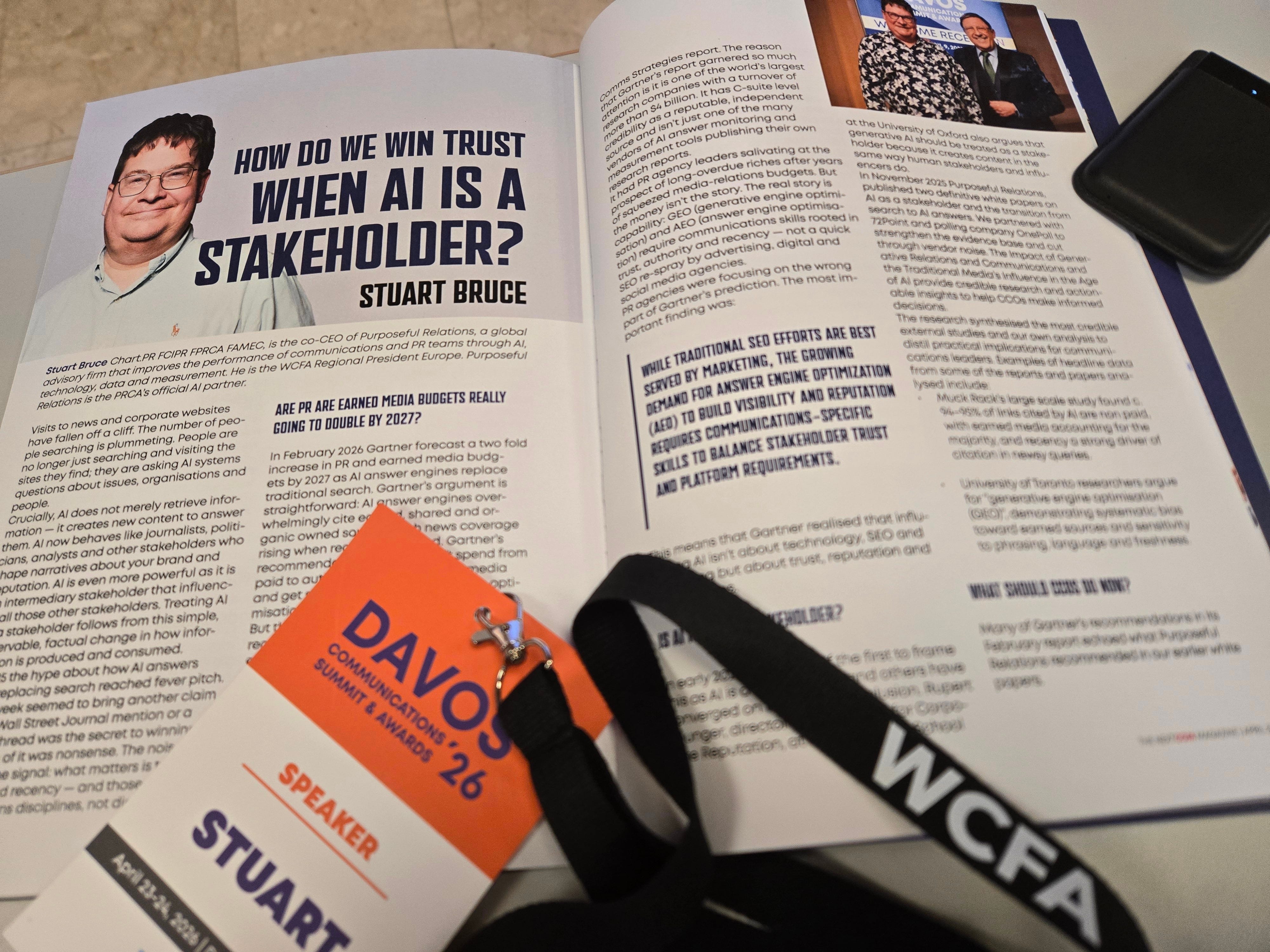
It has articles (and more) by:
Lord David Evans (UK); former general secretary of the UK Labour Party; ‘The trust deficit: political communication at a time of democratic peril’
Maxim Behar (Bulgaria); President of the WCFA and CEO of M3 Communications; ‘About the salt and pepper moments in business’.
Lima Alhawamdeh (UK and Jordan); CEO of AIWIZ Digital Marketing in Manchester and Jordan; ‘The leadership imperative in the age of AI’
Jared Meade (USA); founder of the Rayne Strategy Group; ‘Ethics as strategy: why trust is the ultimate competitive advantage in communications’
Catherine Blades (USA); three time Fortune 500 CMCO and independent board director; ‘Get ready for the new age of PR’
Lars Voedisch (Singapore); CEO of PRecious Communications; ‘AI broke the old agency model for good’
Nitin Mantri (India); President APAC at We Communications and Group CEO of Avian We; ‘From simplification to sense-making: reframing the leadership mandate’.
I contributed an article on ‘How do we win trust when AI is a stakeholder?”.
Accenture rolls out world’s largest Copilot deployment
Accenture has already rolled out Copilot to 20,000 employees, but it was so successful that global professional services firm Accenture is now rolling Copilot out to 743,000 employees in 120 countries. According to Microsoft it’s the largest Copilot deployment to date.
The roll out follows evaluation of its large-scale trial where 97% of employees reported completing routine tasks 15 times faster with Copilot and 53% reported significant improvements in productivity and efficiency.
Many companies have struggled to see significant improvements from Copilot. The secret of Accenture’s success is it had a strategic plan which recognised simply providing Copilot wasn’t enough. It recognised it as major cultural change and conducted extensive one-on-one training with leaders and ongoing group training workshops.
At Purposeful Relations we can’t offer to help with hundreds of thousands of people, but we can help you to achieve the same with dozens or hundreds of people.
NATO shares new disinformation guide
The NATO Strategic Communications Centre of Excellence has published a new report on ‘Beyond Spam Bots: The Rise of AI-powered Disinformation Machines and the Imperative for a Strategic Response.’
It highlights the challenges that corporate affairs professionals now face in defending their organisations from disinformation attacks.
Copilot adds agent capabilities
One reason organisations struggle with ensuring widespread AI adoption with Copilot is the speed at which it is changing. Microsoft has just announced the full rollout of agentic capabilities in Word, Excel and PowerPoint.
This means that Copilot can now be used as a collaborator to actually makes changes to files and documents.
The Purposeful Relations team is part of Microsoft’s Frontier programme, so we get to use and test new features before they are rolled out to all users.
Global Alliance survey on AI in PR and communications management
Global Alliance is conducting a survey exploring how PR and communication professionals responsibly navigate the rapidly evolving AI landscape.
It says it “goes beyond adoption to examine the profession's growing role in responsible AI leadership—from governance and accountability to ethical practice, disclosure, and the reputational stakes that sit at the heart of what we do.”
Please take the survey. It takes about 15 minutes.
The Global Alliance for Public Relations and Communication Management (Global Alliance) is the confederation of the world’s major PR and communication management associations, academic and educational institutions and organisations, representing over 360,000 practitioners and academics around the world.