



We’ve moved! This newsletter originally started out on Substack way back in early 2020. Find out below why we’ve switched back.
In this issue we take a look at research by BCG which shows that CCOs are seriously lagging behind CEOs and the rest of the C-suite when it comes to AI adoption. BCG concludes that this will seriously damage the credibility of CCOs and corporate affairs teams with CEOs and the C-suite.
You might have seen the hype about Claude Cowork and be bemoaning the fact you’re stuck with Copilot. The good news is, you’re not. Microsoft recently launched Copilot Cowork and judging by our early experiments it’s awesome.
We also look at how LinkedIn can help improve your visibility in AI answers and share details of an upcoming webinar where I’ll be interviewed alongside Professor Anne Gregory about AI as a stakeholder and why it matters more to corporate comms professionals than generative engine optimisation (GEO).
Are you one of those who pride themselves on “gut instinct” ability to tell AI writing from human writing because you know all the “tells”. Take a look at an experiment and see what 82,000 New York Times readers think.
This issue also has details of The Guardian’s new generative AI policy for journalists and asks if AI writing is just the same as ghost writing.
Why we’ve switched to Substack
And finally, PR Futurist has returned to Substack after a six year break. We originally switched from Substack to Curated, because it was a platform specifically designed for newsletters that curated news and articles. Unfortunately, service has slipped which is why a series of technical issues delayed this edition.
Now we’ve now switched back to Substack I’ve a little favour. Please share it with your friends and colleagues so more people can benefit from it. Thanks.
AI as a stakeholder webinar with Professor Anne Gregory
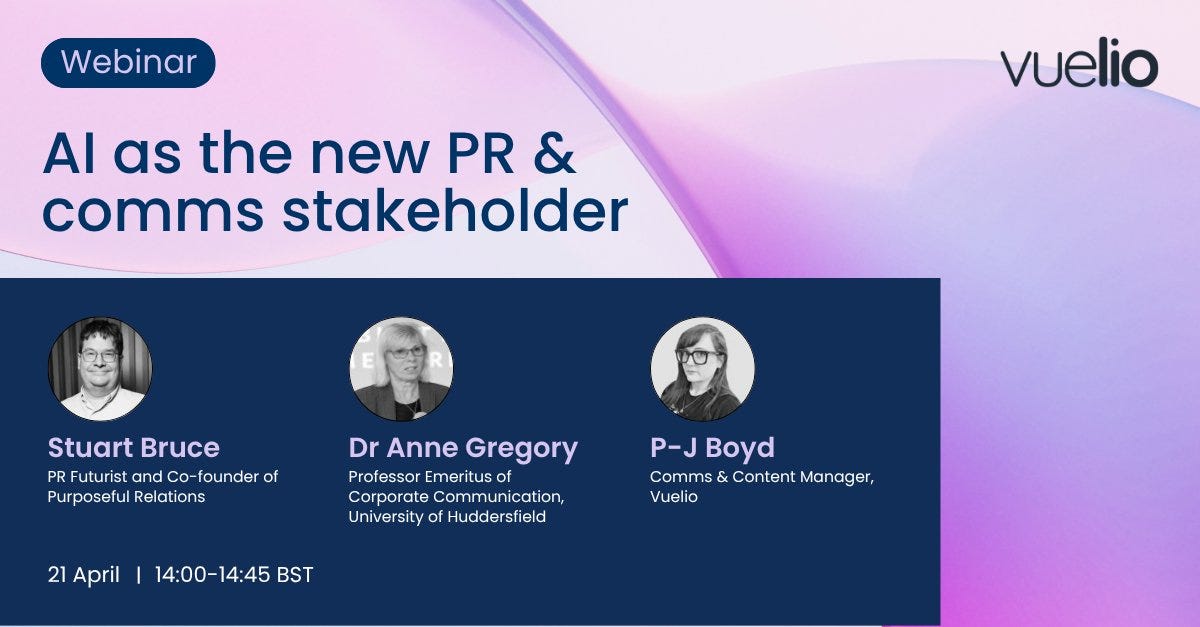
Professor Anne Gregory, Professor Emeritus of Corporate Communication at the University of Huddersfield, and Stuart Bruce, the PR Futurist and co-CEO of Purposeful Relations are the expert panellists on Vuelio’s ‘AI as the new PR and comms stakeholder webinar’.
The webinar on 21 April will explore what this shift means for reputation, stakeholder influence and communications strategy — and where generative engine optimisation (GEO), search engine optimisation (SEO) and answer engine optimisation (AEO) fit within this evolving landscape.
Why this matters: AI is now influencing decisions about organisations, not just efficiency — and comms leaders need to understand that shift to remain credible advisers to CEOs.
Corporate comms failing at AI adoption
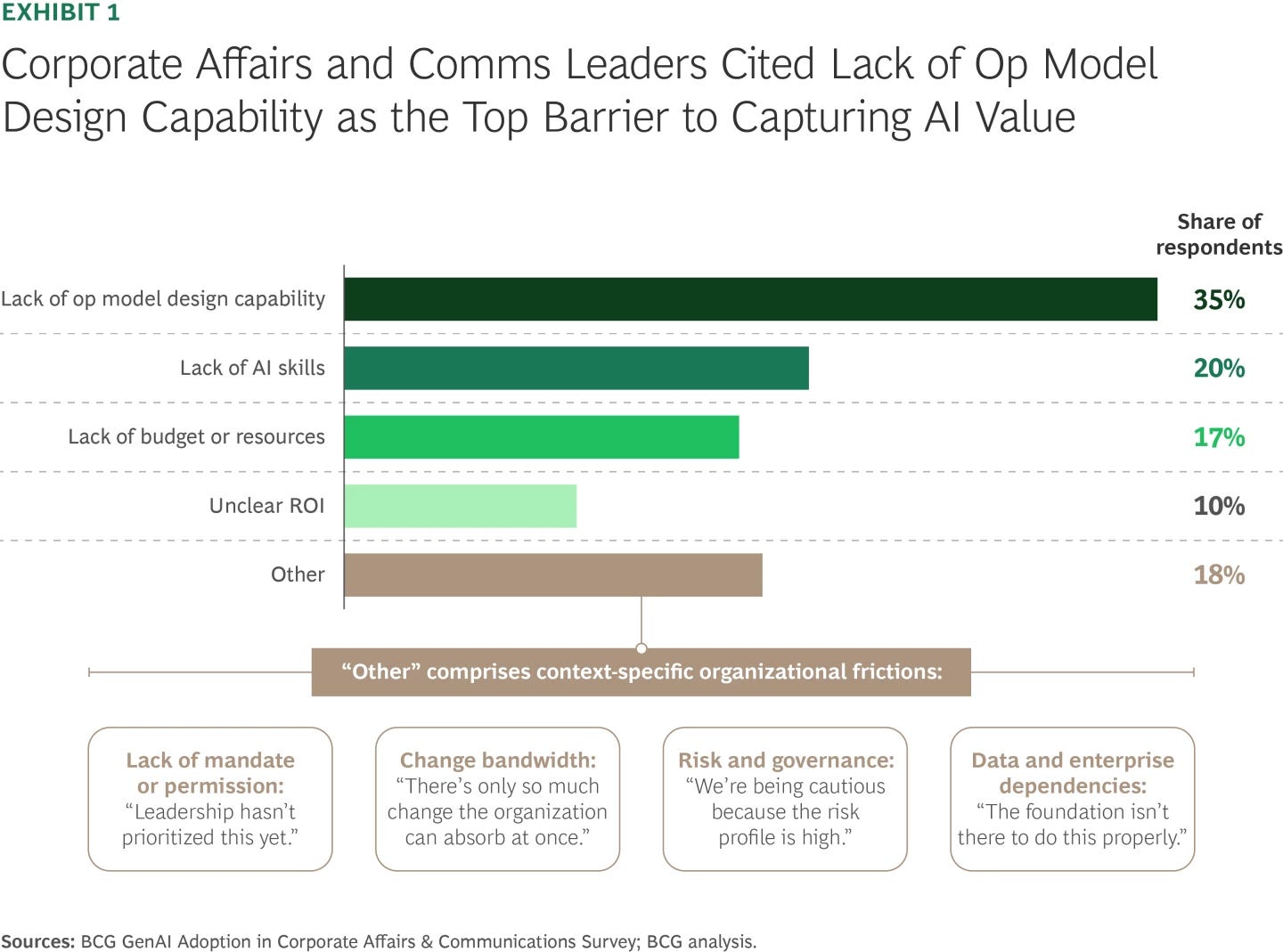
BCG has published a survey of more than 200 senior comms leaders at large companies in the UK and US found a widening disconnect about AI between the C‑suite and corporate communications. More than 70% of CEOs now act as primary AI decision‑makers, while 68% CCOs describe their own function as an AI laggard.
I’ve written an article analysing BCG’s findings and comparing to our own experience of working with comms leaders and teams.
BCG argues that CCOs who put the foundations in place now—governance, skills and scaled integration—will shape how corporate affairs and communications evolves. Those who delay will find that the AI gap quickly becomes an influence gap as they rapidly lose credibility with internal stakeholders and the C-suite.
Our CommsTransform™ IDEA framework does exactly what BCG recommends for successful AI adoption. Talk to us today to find out how we can help you ensure you aren’t one of those failing CCOs identified by BCG.
Why this matters: Falling behind on AI is no longer a capability issue for corporate communications but an influence risk, directly affecting credibility with CEOs and the C‑suite.
Can you tell the difference between AI writing and human writing?
The New York Times ran an article with a quiz to see if readers preferred AI writing or human writing, Those who bemoan AI writing will be disappointed to learn that 54% of respondents preferred AI-written passages.
It’s significant because around 86,000 readers took part and you would expect NYT readers to be reasonably literate and more aware of what they are reading than most people.
It highlights that much of the criticism of AI writing, including by those who claim they can identify it by “gut feel” or “tells” such as em dashes, is in doubt.
The Times of London followed up with a similar experiment (£). It showed two letters on the same topic. One was by a famous person, the other AI-written in that person’s style.
If you have a Times subscription have a go yourself and let us know how well you did. Be honest.
For full disclosure I scored 5/10 on The Times quiz and preferred more human than AI pieces in the New York Times experiment.
Why this matters: If audiences struggle to distinguish AI from human writing, assumptions about authenticity, trust and reputational risk in communications need urgent re‑examination.
Purposeful Relations contributes to the PRCA Strategic Advantage Report

The PRCA Strategic Advantage Report is an expert-written resource to help PRCA members navigate the turbulent times we live in. Contributors include the CBI, PRovoke Media, CARMA, OnePoll, Rigour Research and Purposeful Relations.
We contributed a chapter analysing the likely impact and importance to public relations and communications of the transition from traditional search to AI generated answers. It looks at why understanding and influencing AI should be looked at as AI as a stakeholder rather than a simple alternative to SEO.
The Strategic Advantage Report is a PRCA member-only resource and available to non-members for £850.
Why this matters: The report provides essential expert opinion and insight to enable you to make better business decisions.
Copilot Cowork now available and it’s amazing
This year the AI company that has been grabbing all the attention for AI advances is Anthropic. In February it launched Claude Cowork which can automate entire tasks. It included sector-specific plugins which spooked investors because it looked like it could automate tasks in software, legal, sales, financial analysis, and other professional services. That triggered a broad selloff in related stocks, as markets feared those businesses could be disrupted.
It made Microsoft’s Copilot look antiquated in comparison. But in March Microsoft announced that its partnership with Anthropic meant it would be bringing Cowork to Copilot. It delivered on its promise extremely quickly as it launched earlier this month.
Our early experiments with Copilot Cowork are even better than we’d expected. The first task I tried to automate was helping with event we’re organising. Invitations were sent out via Hubspot. Copilot Cowork then monitored the RSVP emails. Each morning it updated a spreadsheet where it extracted names, job titles, companies and notes from each email. It filed the incoming emails into Yes, No and Out of Office folders. It even coped with replies where the invitee asked if a colleague could attend. And a reply from a mobile that indicated the person had started a new job, but it couldn’t find out where so I should ask them (offering to create an email to do that).
Copilot Cowork is only available if your administrator has turned on Frontier mode (for new experimental features). It’s possible to do this just for certain accounts, so if you’re an early AI adopter (and know how to experiment safely) then it might be worth asking if you can have access.
Why this matters: Task‑level automation shifts expectations about speed, scale and responsiveness, raising governance and capability questions that comms leaders cannot leave to IT alone.
AI in Communications boot camp in Zurich
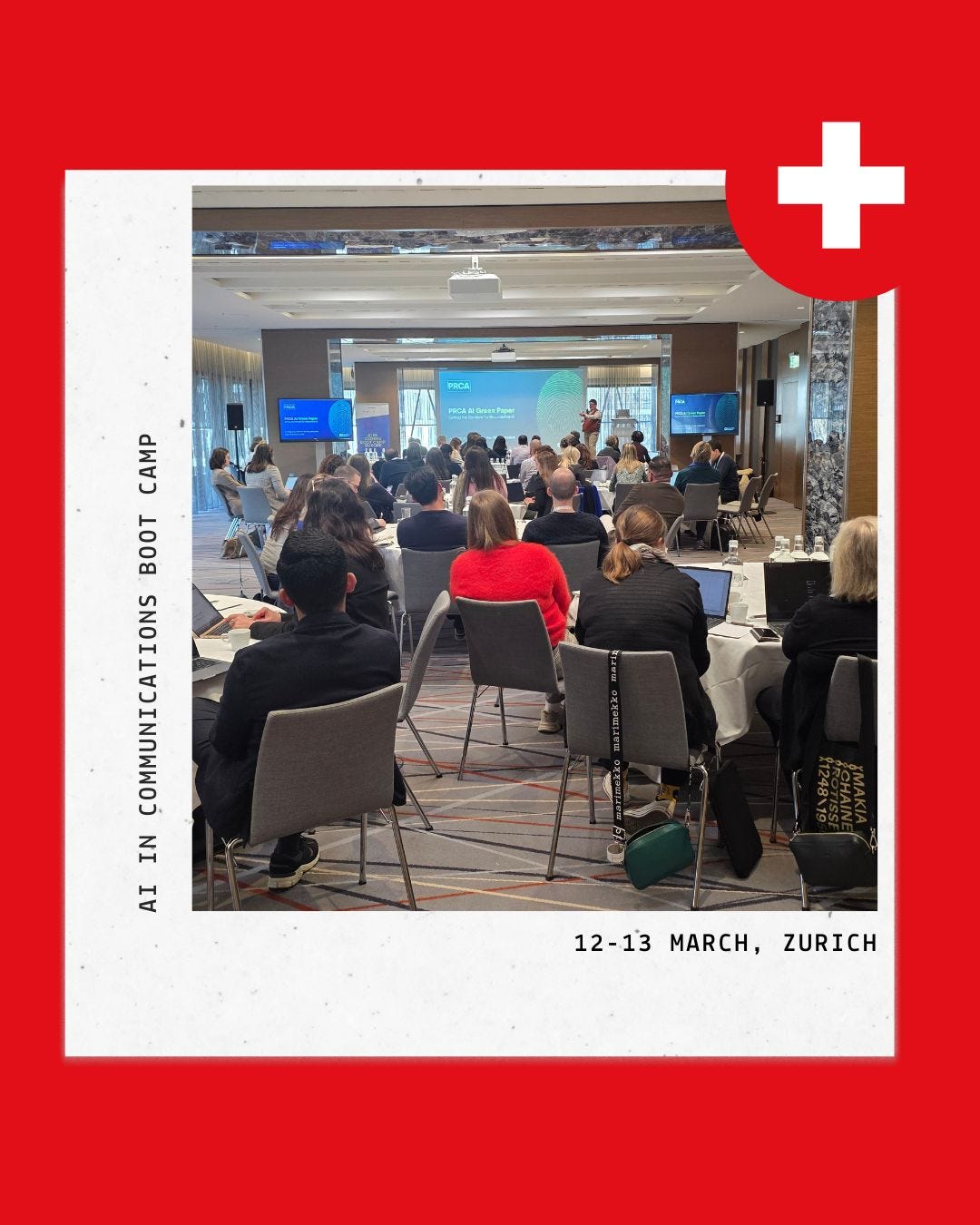
Stuart Bruce was one of the keynote speakers at The P World AI in Communications boot camp in Zurich on the 12-13 March. He followed the opening keynote by Conor Sweeney, Corporate and Public Affairs Leader at Amazon, and Stuart spoke about ‘Building Ethical Guardrails: Ensuring Responsible AI in Communications’.
Conor’s presentation was a behind the scenes look at Amazon’s AI journey in communications—how it all began, the challenges faced, and the lessons learned along the way.
The next two speakers focused on case studies about how two global companies were approaching AI adoption in different ways. Jorunn Aamodt, Global Communications Business Partner, IKEA and Megan Ronaldson, Global Digital Communications Lead, Electrification, ABB, both shared valuable insights into how IKEA and ABB respectively were managing AI transformation for communications and corporate affairs.
Why this matters: The three case studies, and questions asked by the 80+ senior comms leaders, provide valuable knowledge and insight that Purposeful Relations can use to advise our own clients.
Isn’t AI writing just the same as ghost writing?
Isn’t AI writing just the same as ghost writing is an interesting question. This article uses a lot of words to say not very much. However, it’s worth reading as it is a good description of how normal, well established and accepted ghost writing is. It’s not just writing. It’s also sculpture and art where the artists work often isn’t just their own endeavours.
I find it ironic when some PR professionals insist on absolute transparency about AI’s role when most of them have happily written and continue to ghost write quotes and by-lined articles without any transparency with no qualms whatsoever.
Why this matters: The debate exposes a credibility gap in how the profession talks about ethics, transparency and authorship as there is no one size fits all answer.
Purposeful Relations at the PRCA NewBizFest 26
After a sell-out debut in 2025, the PRCA NewBizFest is back on Wednesday 29 April at The Trampery, London. Stuart Bruce and Tim Bailey will deliver a presentation on Leveraging GEO for Agency Growth.
Why this matters: If you are part of the senior leadership team at an agency or consultancy then the speakers are guaranteed to give you actionable insight into how to grow your business. When I spoke last year I learnt loads that I’m now able to do.
Vibe coding for public affairs to create the Machinery of Government
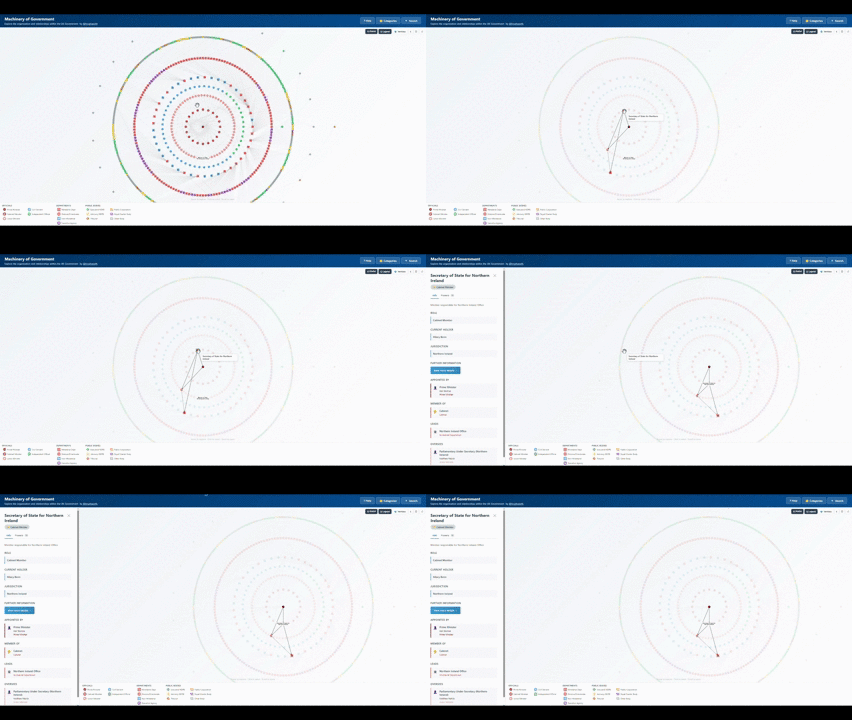
You might have heard of vibe coding but not immediately seen the relevance to what you do. Take a look at the Machinery of Government, an interactive infographic that maps the UK government. It was created by ‘vibe coding’ using Claude. Vibe coding means instead of writing code, you just describe what you want it to do.
This was done by one person (Harry Rushworth) who used Claude to scrape publicly available sources to collect the data, then used Claude to structure the data, before getting it to create the app.
Why this matters: Now everyone (with caveats) can create and code their own apps. The caveat is there are risks so you need policies and training in place first.
Are you coming to the Davos Communications Summit?
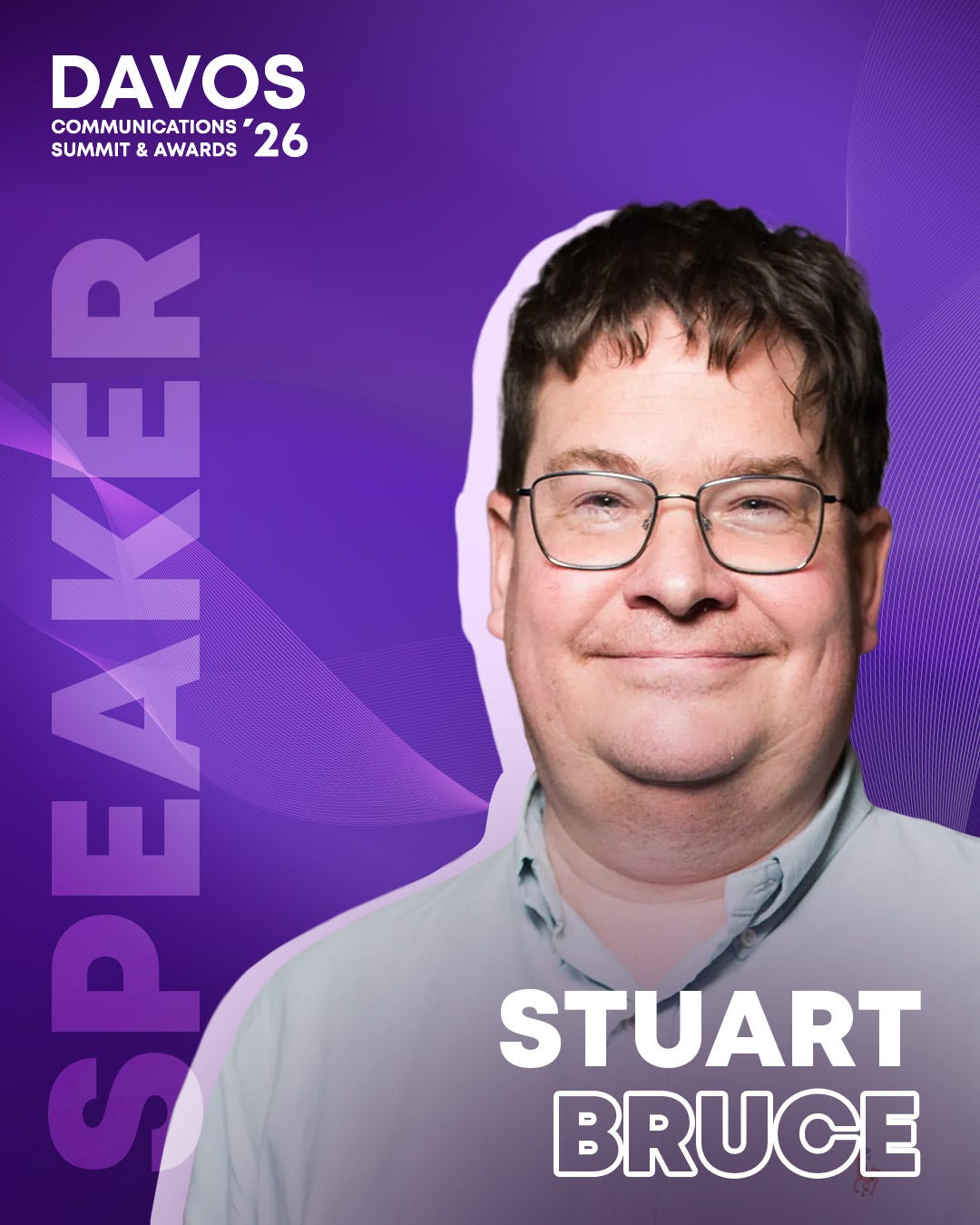
It might start with a cocktail reception on Wednesday 22 April but there is still time to buy your pass for the Davos Communications Summit on 23-24 April. I’ll be there speaking about AI as a stakeholder on the ‘Can you measure trust in an AI world?’ panel.
Other topics include: The trust deficit - political communication at a time of democratic peril; When people become the media; Modern leadership; AI, trust and the new architecture of influence; Under pressure - crisis management in 2026; Will AI replace human communications; Brand now, or be forgotten; Ethics in communication - what’s still OK?
Speakers include: Paul Holmes, founder and CEO of PRovoke Media (UK); Johna Burke, global managing director of AMEC (USA); Lord David Evans, former general secretary of the UK Labour Party (UK); Bar Clara Mendez-McConnon, former Meta EMEA leader (Israel); Sergii Bidenko, reputation and crisis advisor, SEC Newgate (Ukraine); Pamala Proverbs, managing director, PRMR (Barbados); Rodrigue Soffo, CEO, RS Intelligence & Lobbying (Cameroon); Iryna Zolotarevych, advisor to the Minister of Social Policy (Ukraine); Stephen Hahn-Griffiths, chief reputation and strategy officer, The RepTrak Company (US).
Why this matters: Global debates about trust, influence and AI are moving faster than most corporate comms strategies, and CCOs who are absent from these conversations will be reacting rather than shaping outcomes.
How to increase AI visibility with LinkedIn articles
Our own work with clients on AI as a stakeholder and GEO has shown us how important LinkedIn is for influencing AI answers. LinkedIn has now published an article exploring how to leverage LinkedIn for AI visibility.
Why this matters: As AI systems increasingly surface answers rather than links, communications leaders need to understand how professional platforms like LinkedIn influence organisational visibility and authority.
The Guardian’s generative AI and journalism policy
The Guardian has just updated its Editorial Code of Practice and Guidance to address generative AI. I’ve written about it and about attending a round table discussion to discuss the use of AI in journalism.
The round table was organised by the Chartered Institute of Journalists and attended by News Media Association (NMA), the Periodical Publishers Association (PPA), the Society of Editors, the National Union of Journalists (NUJ), Women in Journalism, the British Association of Journalists, the Chartered Institute of Public Relations (CIPR) and the Public Relations and Communications Association (PRCA). I attended and contributed on behalf of the PRCA.
Why this matters: Comms professionals face many of the challenges facing editors and journalists, so can learn from examples elsewhere.
Stuart Bruce to judge PRCA Dare Awards

Stuart Bruce has been invited to join the judging panel for the PRCA Dare Awards 2026, one of the UK’s most established awards programmes for public relations and communications excellence.
The PRCA Dare Awards recognise outstanding campaigns, teams and practitioners across agency, in‑house and consultancy roles. Judges are drawn from senior leaders across the profession and assess entries independently through an online judging process.
Categories include public affairs, B2B, charity/not for profit, best use of data and analytics, media relations, consumer relations, employee engagement, integrated campaign and public sector. There are team and individual awards for in-house, consultancy of the year and rising star.
Why this matters: Industry awards are just self-aggrandisement but can provide valuable lessons and new case studies about best practice.
Tim Bailey provides an Opening Act for the AMEC AI Day North America
The Purposeful Relations team couldn’t be in New York for AMEC’s AI Day North America 2026 which explored how AI tools are transforming communication and measurement. Tim Bailey did record one of the Opening Act videos with a quick walkthrough of how to build an AI agent to help use the AMEC Integrated Evaluation Framework.
You can still buy passes to watch the recordings of the day.
Why this matters: Measurement frameworks are being re‑engineered for an AI‑enabled world, and comms leaders who ignore this risk losing control of how impact and value are assessed.
eYou is a new ethical European social media platform
Remember the halcyon early days of social media? I started my PR blog in 2003 and joined Twitter in January 2007, a few months after it launched. When did you join Twitter?
A new European social media platform, eYou.Social, is trying to recapture the magic before social media was invaded by advertising and became pay to play to beat the algorithms. eYou is “built on trust, transparency, and data sovereignty”. It has built-in fact-checking, transparent algorithms, and full GDPR compliance,
eYou is positioning itself as Europe’s ethical alternative to US and Chinese social media giants.
Why this matters: European alternatives to US social platforms test whether trust, transparency and data sovereignty can be competitive advantages rather than regulatory burdens.
Another CIPR CPD year completed
The CPD year for the Chartered Institute of Public Relations (CIPR) has just ended. Both of Purposeful Relations’ directors completed their submissions close to the deadline. I posted on LinkedIn about successfully completing my CPD and about how, as usual, it was mainly custom submissions. I asked how many other people’s submissions were mainly custom entries.
The post clearly struck a nerve as it generated 30 comments and 58 reactions. Most of the comments were people agreeing that they mainly did CPD using custom submissions.
I made the suggestion that it would make it easier for members and reduce the workload for CIPR staff if it was made easier to create custom submissions that were then added to the database.
Why this matters: The Purposeful Relations team is constantly learning as we need to the latest expert knowledge to be able to give the best advice. Learning is a joy that proves useful everyday by enabling you to be better at your job and life.