


I hope everyone is enjoying the sun and working hard. Alongside work I’ve been supporting my daughter with her A-levels. Last one was yesterday.
We’re celebrating by going to Makerfield today to campaign for Andy Burnham in the by-election. I’ve been a couple of times already. Andy is an old friend as I was his director of communications in his first bid to be Labour leader in 2010. PRWeek asked me to write about it.

In this issue
Humble brag - I’m one of EMEA’s top 25 innovators.
Corporate affairs leaders say 2026 is the year of AI, but three quarters don’t even have a strategy
Copilot Cowork now available to everyone
Why you change your company if the AI answer about it is wrong
Microsoft’s Satya Nadella says corporate value is a learning loop between people and AI
Burson bets on AI as a stakeholder and GEO
CIPR publishes best practice guide on responsible AI use in PR
Humble brag - I’m one of EMEA’s top 25 innovators
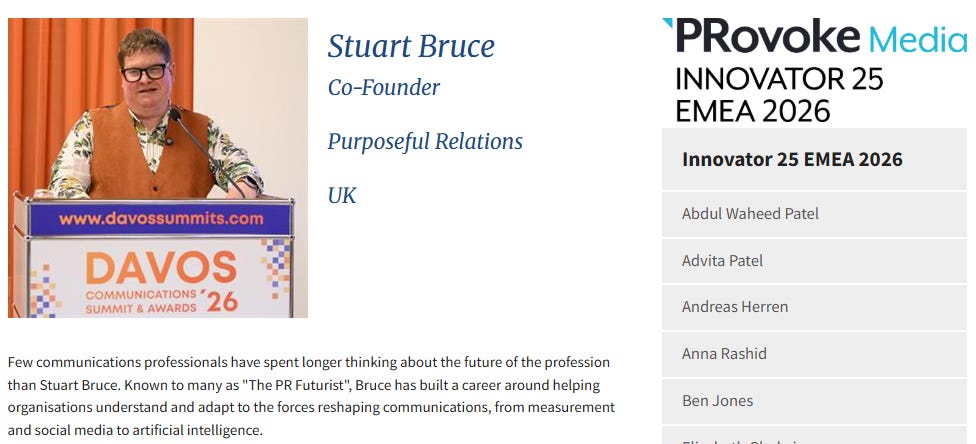
I’m humbled and excited to be listed in the PRovoke Media 2026 Innovator 25 for EMEA list of 25 communications professionals across Europe, the Middle East and Africa who are helping shape the future of the industry. PRovoke says the list recognises "communications professionals who are challenging established thinking, embracing new approaches and helping organisations navigate an increasingly complex environment."
About me it says: “Few communications professionals have spent longer thinking about the future of the profession than Stuart Bruce. Known to many as "The PR Futurist", Bruce has built a career around helping organisations understand and adapt to the forces reshaping communications, from measurement and social media to artificial intelligence.
"Today, through Purposeful Relations, Bruce advises communications teams and agencies on innovation, transformation and AI adoption."
Congratulations to all the other stellar people listed which include: Comms Rebel Advita Patel; Tangerine's Anna Rashid; Paul Stollery, co-founder of Hard Numbers; Dr Peter Klomp, head of advocacy and campaigns at UEFA; Ishtar Schneider, global external comms lead (purpose & sustainability), Royal Canin; Mark Lowe, CEO, Third City; and many more.
Huge thanks to Maja Pawinka Sims, Paul Holmes and the PRovoke Media team.
Corporate affairs leaders say 2026 is the year of AI, but three quarters don’t even have a strategy

When asked to complete “2026 is going to be the year of….”, corporate affairs leaders most often answered AI. Despite this just a quarter have a formal AI strategy.
This is just one of the fascinating findings in the 2026 Corporate Affairs Report from consulting giant Deloitte. It also revealed a lack of understanding about the real value of AI to a corporate affairs team as content creation and drafting was cited as the main use.
It also doesn’t tackle the huge impact that AI as a stakeholder and GEO is having on corporate affairs professionals.
I’ve written a more in-depth analysis on my blog.
Copilot Cowork now available to everyone
Remarkably Microsoft 365 Copilot Cowork is now generally available to every licensed Copilot user. Given how powerful Cowork is it is remarkable that Microsoft released a test version (for Frontier users) so quickly and that it has come out of testing in just three months.
Traditional AI is where you put in a prompt and get an answer. Cowork is a full AI assistant. It can do complex, long-running tasks using multiple tools. You define the task and Cowork goes off to do it and returns when it is finished. It can also browse the web using your local Edge browser (complying with existing security policies).
Because it runs in the cloud Cowork keeps running even when your computer is off and crucially means that Microsoft’s enterprise grade security is strongly enforced. Because it uses Work IQ it is fully grounded in your work so understands context far better than third-party AI tools.
If you are concerned about deploying it in a live environment then be reassured the testing was robust with companies like Accenture, Koch and Zurich Insurance.
You need a Copilot licence to use Cowork and then there is a bill for usage. Microsoft has created a spreadsheet to help you estimate this. It shows a ‘corporate knowledge worker’ will use about £106 ($142) of Copilot credits per month and a ‘senior leader will use £61 ($82).
I think it overestimates the costs, especially in the first few months of use, as I don’t think most users will do as many prompts as Microsoft’s spreadsheet shows.
When I say Cowork is available to everyone, it needs to be turned on by your admin first. Admins can also set spending caps at tenant (total), group and even user levels. Users can request additional tokens. It is ‘pay as you go’ so if you set sensible limits it is very affordable.
Our next in-house Copilot training workshop for a client is next Tuesday so we’ll be rapidly rewriting the agenda to embed Cowork into the day. Let us know if you want us to run a Copilot for comms workshop for your team. The ‘pay as you go model’ means it is even more important that users have advanced training to make sure they know how to use both Copilot and Cowork effectively in a PR, communications and corporate affairs environment.
Why you change your company if the AI answer about it is wrong
If you’re monitoring AI answers about your company and they are wrong then the natural instinct of most communication professionals is to fix it. But what if instead you changed your company to make the answer right?
That’s exactly what music-education platform Soundslice did. It noticed that its error logs showed users uploading images of “ASCII tabs” into its platform. These are a used by guitarists as a simple way of writing down their music.
ChatGPT told users that Soundslice could turn these into audio playback. It couldn’t. Instead of using GEO techniques to try and correct the error Soundslice simply built the new feature.
something strange in his error logs. Users kept uploading screenshots of ChatGPT conversations containing ASCII guitar tablature, expecting his sheet music scanner to turn them into playable audio. It couldn’t. It never had. ChatGPT had simply decided, confidently and repeatedly, that the feature existed, and was sending people to Soundslice to use it.
The AI answer was more authoritative than the company’s reality, and the fastest, cheapest way to correct it was to change the product. Ignoring it wasn’t an option as it made the company look bad to potential new users who found it via AI. It added ASCII tabs to what it already did, which was turning actual musical notation into audio.
This might be an amusing story about a small company, but it raises questions for professional communications about how to operate in a new media environment. Soundslice was smart as it turned a damaging issue into a positive one. The fact so many people were asking the question showed there was demand.
Microsoft’s Satya Nadella says corporate value is a learning loop between people and AI
Microsoft CEO Satya Nadella has published an article on his SN scratchpad blog on how he sees the future of AI in organisations. He argues organisations will win by valuing human expertise combined with AI in a continuous learning loop to share the value across the ecosystem, and not obsessing on the latest AI models.
It’s not a new perspective but it does challenge the concept of ‘frontier’ models and the AI evangelists who aren’t constantly chasing the latest shiny tool.
Satya’s perspective endorses Purposeful Relations’ own people first attitude to AI, but with an interesting framing. He frames it as an organisation’s value is its “human capital” and its [AI] “token capital” combined, with people being the most important part.
Burson bets on AI as a stakeholder and GEO
PRWeek has a fascinating interview with Burson’s UK CEO Simon Redfern. The most interesting part was what he had to say about the “big opportunity” of generative engine optimisation. He says: “We are now optimising to talk to AI. That is a stakeholder for us.
“It feels like a real renaissance moment for us in the industry”.
He hints about Burson’s approach when he says: “lots of agencies are developing tools and we will likely have more to say on how we’re going to package this up for clients.”
I’ve been vocal about why the build it in-house approach is wrong because what’s best for clients is a robust methodology combined with intelligent selection of a best in class mix of tools.
Interestingly, Burson is trialling a training programme where staff can train for five hours a week to improve their GEO capabilities.
This is interesting because it aligns with the advice and support we give clients, which is that everyone needs to understand GEO and AI as a stakeholder because it is integral to all aspects of communications. Many agencies are treating it as a speciality and hiring a GEO lead to create a specialist team. This misses the point entirely.
Ironically, this doesn’t appear to be the reason Burson has done this. Simon’s innovative approach to the challenge of hiring people with GEO expertise means Burson is inadvertently creating a better structure.
CIPR publishes best practice guide on responsible AI use in PR
The Chartered Institute of Public Relations (CIPR) has published a new best practice guide on the ethical use of artificial intelligence in PR. It is based on Global Alliance’s Venice Pledge and aims to translate the pledge into practical guidance.
It’s a good guide but still struggles with trying to overly simplify something that is complex and context based. This risks perpetuating some of the myths about AI use. Many practitioners are wrong or confused about the privacy and confidentiality of AI systems. They remember the early days of ChatGPT and how it ingested everything into its large language model. They don’t know this is no longer true in the same way.
For example on the first pledge - Ethics first on page 6 - it emphasises confidentially risks and warns about the risk of “feeding confidential information into these systems”. But it doesn’t make clear the difference between free and personal tools where this is true and business and enterprise tools where it isn’t.
It risks discouraging practitioners using AI effectively, which ironically could potentially be a breach of the CIPR’s own Professional Code of Conduct. The code says members must deliver work: “competently: that is, in a timely, cost-effective, appropriate and thoughtful manner”.
In 2024 Sir Geoffrey Vos, Master of the Rolls and the head of civil justice in England and Wales argued that it was potentially unethical for lawyers not to use AI as without it they weren’t performing as effectively as possible. The same logic applies to CIPR members and its code of conduct.
On the Practitioner Checklist on page 13 it does clarify it by saying “Do not enter confidential client or employer information into public AI systems without checking their data policies.” But I don’t think most users will understand the difference between “public” and a business grade security AI tool.
For the inexperienced AI user (which is surely who a best practice guide is aimed at) this is dangerously misleading.
Pledge 4 on transparency makes no reference to the legal aspects from the EU AI Act where the transparency provisions come in at the start of August.
One of the reasons I encouraged the PRCA to publish its Green Paper (which I contributed to) on the responsible use of AI is because creating a ‘one size fits all’ ethics guide isn’t possible.