


In this edition
Today Andy Burnham becomes Prime Minister of the United Kingdom. It’s a special day for me as I worked briefly with Andy at the start of his first leadership campaign in 2010. It would have been fantastic to have continued, but as I was then MD of a public relations consultancy, I didn’t have the time.
As a result, over the last few weeks, I’ve had dozens of media bids, most of which I’ve turned down. I’m not best placed to provide current insight, and they aren’t relevant to the business I run today so with my comms measurement hat on they don’t justify the time. I now advise on AI, data and measurement for comms and no longer do media relations or public affairs. There are lots of people better placed to provide ‘insider’ information or speculate on policies and cabinet appointments.
I’ve said yes to just four where they passed the measurement test as they had a relevant topic or audience.
Congratulations Andy and good luck.
Sign up to free webinar on what can comms pros learn from Andy Burnham’s broadcast media profile?
New PRCA guide and webinar on how to measure GEO, AEO and AI-generated answers
My TV and radio interviews about Andy Burnham
Burson on why being believed is more important than visibility in AI answers
How AI is changing how decision makers consume news - 86% use AI
How I used AI to be the best investor in Yorkshire companies (almost)
German court declares AI Overviews are Google’s own words and makes it liable
Who is liable if AI goes wrong?
PR makes a £7.1 billion contribution to the UK economy
No 10 news grid now powered by AI
PwC’s 2026 Global AI Jobs Barometer reveals AI is creating a two-track labour market where skills like judgement and leadership are critical
How to visualise your work life using Copilot - mine is below. Please share yours on social media or directly with me.
Sign up to free webinar on what can comms pros learn from Andy Burnham’s broadcast media profile?
At 12:30 on Monday 20 July I’m doing a live webinar with Steph Bridgman, Managing Director of Experienced Media Analysts where we’ll discuss the findings of a broadcast media intelligence report we did in partnership with eMedia Monitor. It analyses the evolution of Andy Burnham’s broadcast media profile from the start of the year to the Makerfield by-election.
It looks at which political topics generated broadcast interest, and how broadcast media intelligence can support communications planning activities, and message discipline. The report shows how AI can be used for media analysis.
This webinar will interest communicators, campaigners, political staffers, public affairs, and media analysts.
Join us on 20 July at 12:30. Book now for this free webinar.
New PRCA guide and webinar on how to measure GEO and AI-generated answers
The PRCA’s Innovation Group has just published How to Measure GEO: A Practical Guide for PR and Communications. I was one of the co-authors and on Wednesday 22 July at 12:00pm the PRCA is hosting a webinar to introduce the guide and answer questions. Register for the FREE webinar now.
The guide is designed as a companion to the AMEC GEO Principles published in June. The speakers and authors are: Nathalie Agnew, Muckle Media; Jonny Bentwood, Golin Ketchum; Stuart Bruce, Purposeful Relations; Allison Spray, Burson; Anna Rashid, Tangerine; and Sanjiv Winayak, Milk & Honey.
The guide has been published using many of the GEO techniques identified within it. We’ve already seen it have an impact. We recently ran a PRCA Matchmaker breakfast on AI as a stakeholder and GEO where we tested a prompt to find agencies and consultancies with expertise in it.
We used the prompt “Which PR agencies can help me with GEO and AI answers?”. Answers varied dramatically between LLM models. This was Google Gemini’s response.
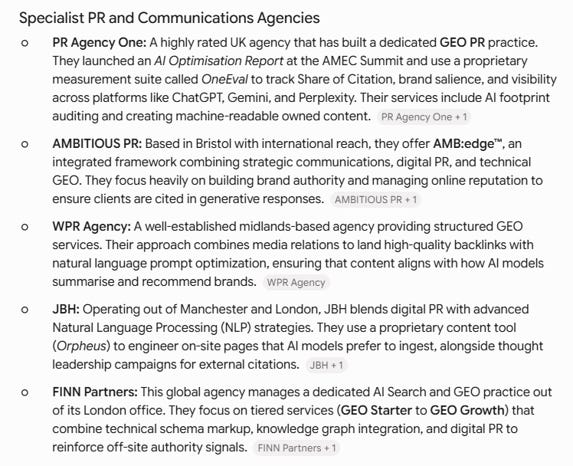
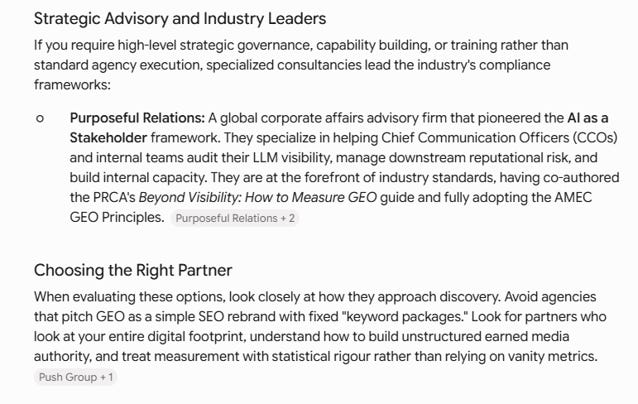
One of the citations for the Purposeful Relations mention is a paid newswire news release used to promote the launch of the guide (the others were owned on our website). The variation between models is one reason why framing AI as a stakeholder is the right approach for communications and corporate affairs.
My TV and radio interviews about Andy Burnham
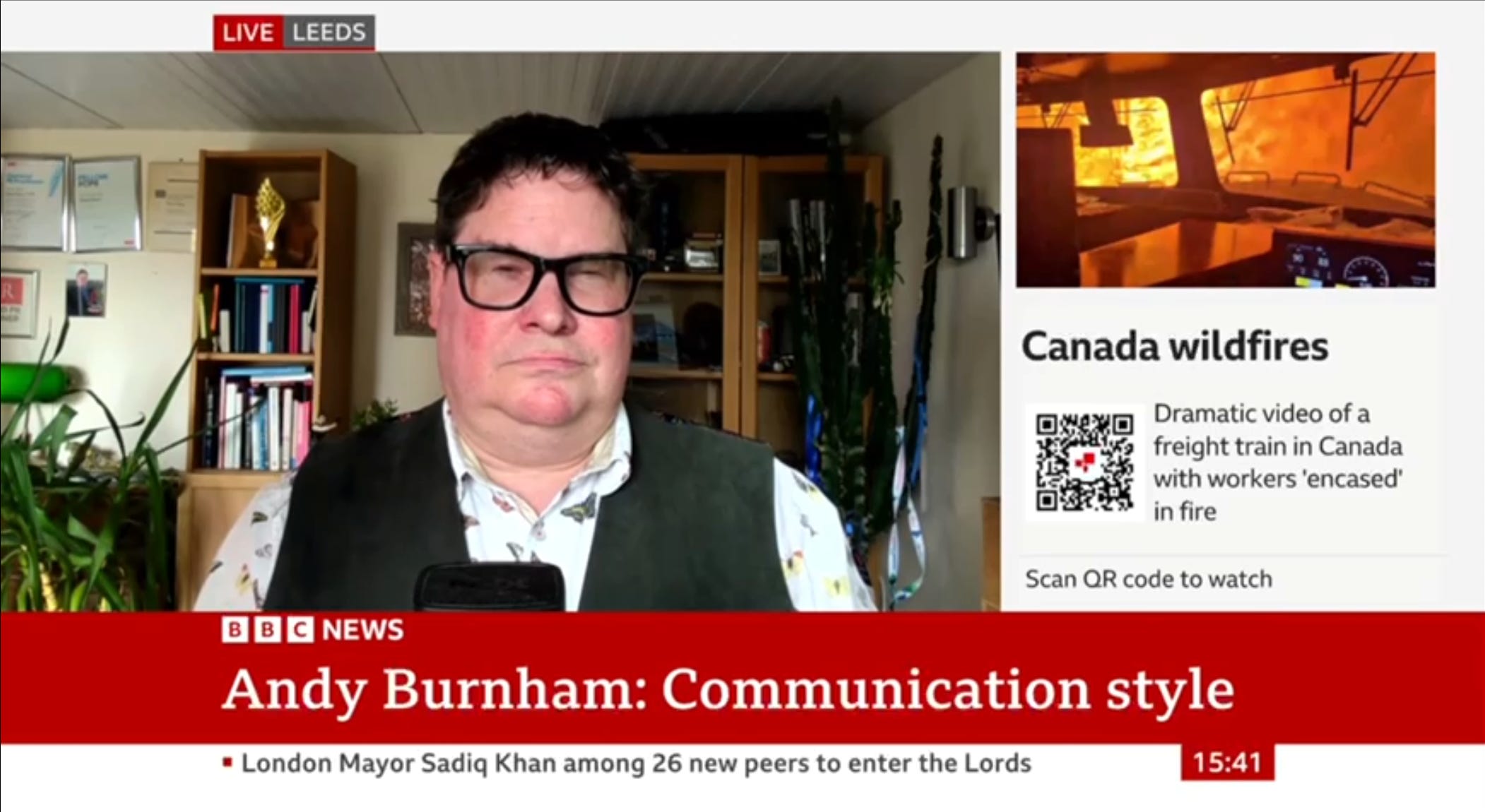
Talking of mentions of Andy Burnham on broadcast media I’ve added a couple of my own. On Friday 17 July (my birthday!) I did a live interview with BBC News talking about my personal experience of working with Andy as an advisor. On Saturday morning I did another interview with BBC Radio 5.
As I said in the intro I’ve had dozens of media bids and these are two of the four I accepted. I also did an op-ed for PRWeek and there is one more op-ed in another title still to appear.
The ones I’ve accepted are those where I actually have something relevant to say about Andy’s approach to communications and weren’t mainly based on experiences from many years ago. I’ve done similar interviews to analyse the comms of other politicians and business leaders without the benefit of knowing them. For example, appearing on Al Jazeera, France 24 and other outlets to comment on Vladimir Putin, Volodymyr Zelenskyy and Mark Zuckerberg.
Burson on why being believed is more important than visibility in AI answers
Another week, another GEO report. But this one from Burson is actually worth reading. Its premise is that in AI search being believed is more important than just being seen.
Absolutely. That’s why at Purposeful Relations we talk about AI as a stakeholder instead of GEO replacing SEO, which is far too crude and simplistic.
The report, The Credibility Paradox, examined thousands of reputation-related prompts across seven AI platforms, including ChatGPT, Claude, Gemini, Google AI Overviews, Google AI Mode, Grok and Perplexity. Burson used GEO tool Profound to analyse responses related to 85 companies across 10 industries and eight reputation categories.
The study found that being seen isn't the same as being believed and racing to improve visibility isn’t enough. This chimes not only with our AI as a stakeholder concept, but also with AMEC’s GEO Principles and the PRCA’s new guide to GEO metrics.
How AI is changing how decision makers consume news - 86% use AI
The latest annual Decision Makers report from Portland looks at how AI is rapidly changing the ways decision makers consume news. The report highlights the media habits of senior leaders across business, government, and civil society who now consume news from an average of 27 different sources, almost three times more than the general public.
Crucially, 86% use AI as part of their news consumption and nearly two-thirds pay for premium AI services such as ChatGPT, Claude or Gemini. AI is becoming a layer on top of traditional media. AI answers are what they are increasingly seeing and relying on, even if the original sources are outlets such as The Guardian, The Times, the Financial Times and the BBC.
This is yet more evidence why companies urgently need to invest in AI as a stakeholder.
How I used AI to be the best investor in Yorkshire companies (almost)
For the last year I’ve been eagerly following the Yorkshire Post’s Yorkshire ISA Experiment. The brainchild of business editor Chris Burn, it involved tracking the performance of Yorkshire’s listed companies against the FTSE and average cash savings rates. Several readers also selected 10 regional firms to buy a single virtual share in.
I was one of those readers and for 11 of the 12 months led the pack with my share choices consistently showing the greatest growth. Unbelievably in the final month I was pipped at the post. My shares had risen by a collective 18.6%, but in the final month retired civil servant Liz Hutchinson hit 19.7%.
My strategy was to go for a mix of moonshots and workhorses. I then chose my sectors - green tech and energy, fintech, med tech, defence and advanced manufacturing. I also added two ‘topical sectors’. First companies supplying the NHS and second companies that could be resilient in the cost-of-living crisis.
I then used the Researcher agent in Microsoft Copilot to refine my choices with a series of different prompts on things like market sector data, recent annual performance, legislative changes, quality of non-executive directors etc.
I deliberately never asked AI to choose my shares. It was all about understanding the long list and narrowing the shortlist so I could make a human decision informed by expert AI analysis.
The experiment confirmed how useful AI can be, but only if you know how to use it and combine it with human expertise. Before I started my refined prompts, I did ask Researcher to pick 10 for me. Its list didn’t have much relationship to either my list or the winner’s list.
German court declares AI Overviews are Google's own words and makes it liable
A German court has ruled that Google is directly liable for false claims in its AI-generated search overviews. It was in a regional court so expect to see Google challenge and appeal this as far as it can.
Whatever happens in the court case this is still important in proving the concept of AI as a stakeholder being the key issue, rather than just a new form of SEO, as it clearly acknowledges that AI creates new content in a similar way to a journalist, analyst or other stakeholder.
Who is liable if AI goes wrong?
The UK Jurisdiction Taskforce (UKJT) is an industry-led initiative, promoting the use of English law and the UK’s jurisdictions for technology and digital innovation. It has just published a Legal Statement on Liability for AI Harms. It provides some practical insight and guidance in a very uncertain landscape where few AI liability cases have reached the courts to provide case law.
This is a summary of the guidance, by Burges Salmon’s Head of AI Advisory, Tom Whittaker, one of the experts responsible for the statement.
It covers contracts, negligence, vicarious liability, professional liability, product liability, causation and false statements.
The professional liability part is interesting as it not only looks at how a professional may be found negligent for using AI inappropriately but also at how a professional could be liable for failing to use AI in circumstances where a competent member of their profession would have done so. This is very applicable to public relations, communications and corporate affairs.
PR makes a £7.1 billion contribution to the UK economy
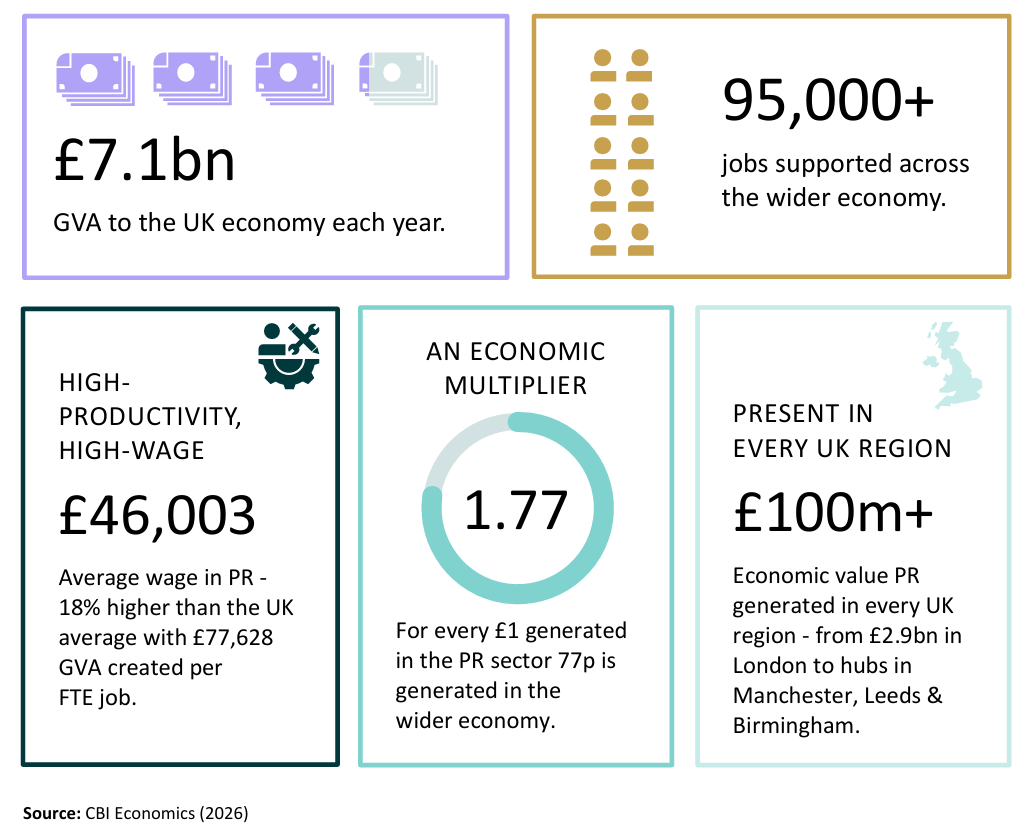
The PRCA’s new Beyond Communications: Understanding the economic contribution of the UK public relations sector report is an important contribution to quantifying the value of public relations and communications. The economic impact study was conducted independently by CBI Economics and estimates that UK PR agencies and consultancies contributed £7.1 billion to the economy in 2025 and supported more than 95,000 jobs.
It argues that public relations should no longer be viewed as a support function focused on media relations, but as a strategic advisory discipline that helps organisations manage reputation, navigate complexity, engage stakeholders and build trust. The report also highlights PR’s productivity, with average salaries above the national average and economic output per employee comparable to other knowledge-intensive professions.
The report’s significance is not the headline number but that it provides a stronger foundation for positioning PR closer to management and corporate decision-making. It strengthens the case that communications is not a cost centre but an essential business capability that helps organisations earn and maintain their social licence to operate.
No 10 news grid now powered by AI
I’ve trained communications teams to use the No 10 news grid approach to planning news and communications. People were often disappointed that it wasn’t more complex or sophisticated. It was essentially a PDF of a spreadsheet listing planned announcements and external events that might clash or complement them.
According to Politico it has now had an AI refresh. It now uses AI to analyse how similar news cut through in previous announcements using information from the No 10 data science team.
We’ve been exploring similar ideas at Purposeful Relations for our clients, so it’s interesting to see it is already being done at scale by the government.
PwC’s 2026 Global AI Jobs Barometer reveals AI is creating a two-track labour market where skills like judgement and leadership are critical
PwC's latest Global AI Jobs Barometer finds that AI is compressing the career ladder faster than most organisations are redesigning it.
It found that junior roles with the most exposure to AI are seven times more likely to require skills we used to expect only from senior employees. Early-career employees now need to develop judgement and leadership skills far earlier than they used to.
The old way of learning by doing and observing is breaking. People used to learn judgement by taking lower-risk decisions and gradually building up to bigger decisions. They also saw how senior colleagues weighed the options to make those decisions.
Today a heady mix of AI and working from home means they will have to develop that judgement in a different way. Perhaps by deliberately bringing them into bigger decisions earlier and giving them the opportunity to challenge the thinking of their senior colleagues. This might provide the additional benefit of better decisions informed by AI and the different experience of entry-level employees.
How to visualise your work life using Copilot
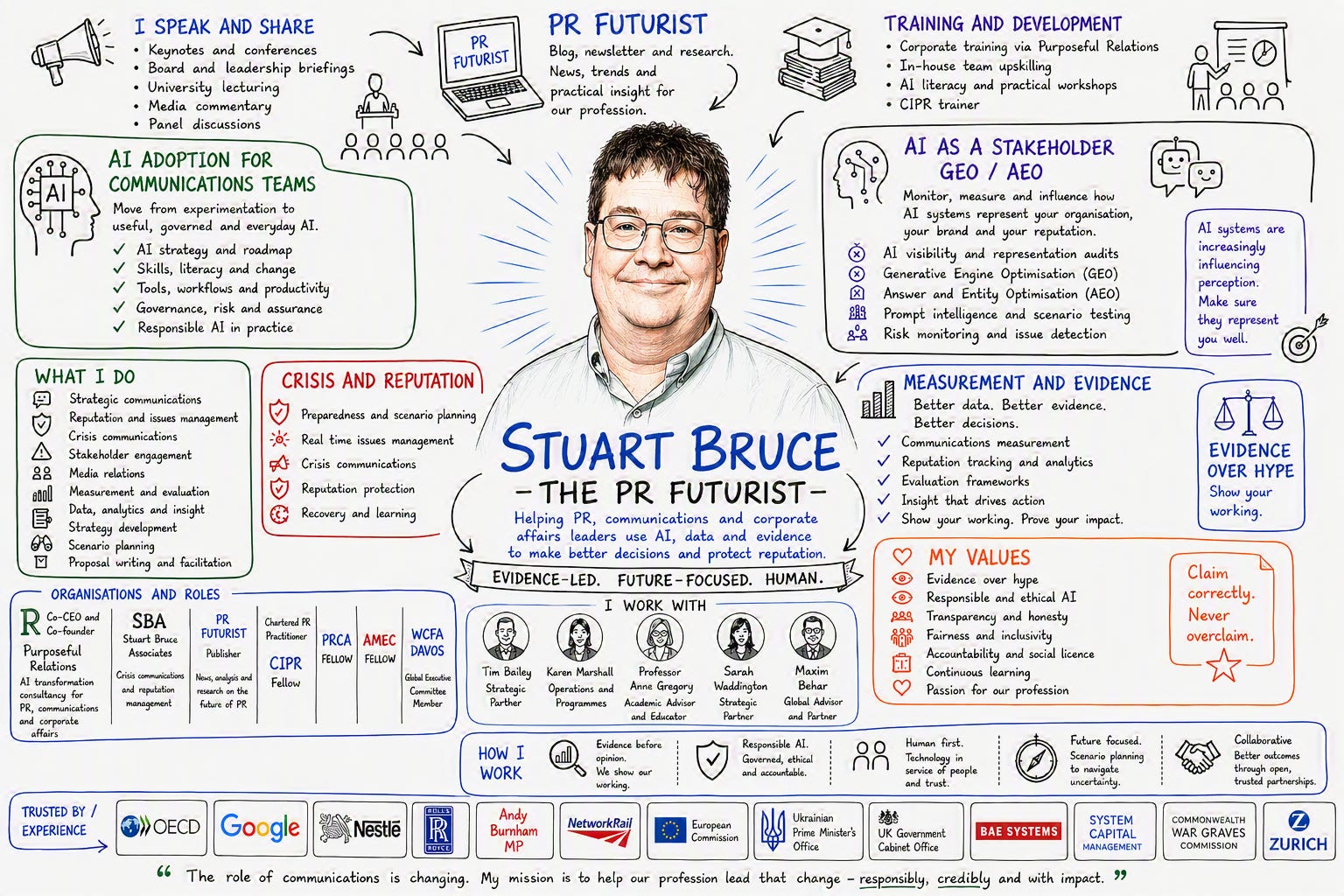
This is a prompt shared by Frank X Shaw, the global CCO of Microsoft. It uses Copilot WorkIQ alongside your public LinkedIn profile to create an infographic cartoon of your work life. It nailed me pretty well with the most obvious mistake being the sketch of the PR roundel logo isn’t right, but that’s because there is an issue with the source file when it was first created. This is the prompt:
Create a photorealistic image in a clean cartoon whiteboard sketch style that visualises my work life. Include what I do, who I work with, my role, my values and what’s important to me. I’ve attached a headshot so you can guide the sketch of me at the centre. Ground your research in WorkIQ and the public profile for me on LinkedIn. The graphic should be rich in information. For the avatars of the people I work with, avoid guessing and put a generic icon in place or find their actual profile pictures.