


In this issue of PR Futurist we look at:
Strengthening public trust in the age of AI-powered search
Reputation in the age of AI talk
Invite only breakfast about ‘What is AI saying about your organisation?’
Accuracy of AI answers about the news
AI misuse is now the biggest threat to corporate reputation
US political campaigns using GEO to influence voters
PRCA Leaders’ Lunch
Judgement Economy
How Russia is influencing AI large language models
Daily Mail testing GEO ahead of an AI visibility product
My Onclusive On the Road chat
New frontier models and multiple inboxes in Microsoft Copilot
The PRCA Census
Strengthening public trust in the age of AI-powered search
We still come across corporate affairs leaders who question whether AI search and AI-generated answers are something they need to take seriously and incorporate into their communications strategies. They should wonder no longer. A new announcement shows just how seriously the UK government is taking the issue.
Not only has GCS (Government Communication Service) launched a guide and new framework for GEO/AEO, but it has also published case studies about its early work.
The 'Strengthening public trust in the age of AI-powered search' guide including its PRIME framework, is an impressive piece of work. The PRIME framework sets out five stages to help communicators manage their reputation in AI answers: Plan, Respond, Implement, Monitor and Evaluate.
What’s interesting is it focuses primarily on the accuracy of AI answers. It says:
“The UK Government is responsible for supporting people with vital, accurate information from health and security issues to how to pay taxes or claim benefits. If we don’t respond to this challenge, we risk outdated, incomplete or, worse still, inaccurate information reaching our audiences, with real world consequences. There is a reputational risk when government responses do not show up reliably in AI search outputs.”
This is a critical issue for corporate communications. Marketing and SEO often have far too narrow a focus on visibility in AI answers, treating it as the AI equivalent of ranking in traditional search. But AI reputation is far more complex. It isn’t simply whether an organisation appears in an answer, but what the AI says, which sources shape that answer, whether the information is accurate and how it affects trust and reputation.
While the framework and guide are excellent, I think they have scope for improvement. PRIME aligns fairly well with Purposeful Relations' AI as a Stakeholder framework, but has some gaps that need exploring. That’s possibly because it draws on the PRCA’s ‘How to measure GEO’ guide that I co-authored earlier this year.
It mostly complies with the seven AMEC GEO Principles.
It aligns very strongly with two of the principles: “Evaluate search and content readiness” and “Prioritise reliable, trustworthy and current sources”. It aligns strongly with three others: “Measure against communication objectives and stakeholder needs”, “Assess the upstream information environment” and “Use GEO ethically to improve the information environment”. It has only partial alignment with “Treat AI outputs as directional and test transparently” and “Distinguish visibility from outcomes and impact”.
Accuracy of AI answers is one of the things we support corporate and government clients with and where we differ from those just offering GEO/AEO support. Too much about GEO is focused on crude visibility in AI answers which is fine for some marketing but isn't where the risks and opportunities lie from a broader organisational perspective.
There are elements I’m less convinced about. For example, it lists several “Tools built specifically for AI chat visibility”, but I’m not convinced these are necessarily the right ones.
But my biggest concern is that it doesn’t actually cover how to measure the accuracy of AI answers. The section recommends using GCS Assist, but unless it has had a major upgrade since I last saw it can't actually do that. There is a lot of complexity and potentially huge volumes of data involved. We're already working with an arms-length body on an important project looking at this issue.
The four case studies are:
HMRC used rapid-response alerts and structured gov.uk guidance to correct misleading VAT deadline information in AI search outputs.
HMRC created an integrated ‘connected search’ model across paid, organic, and AI search to cut campaign costs and increase visibility.
UK Health Security Agency restructured health advice to improve visibility in AI overviews, increasing blog views by 160%. Read the UKHSA case study.
Office for National Statistics evaluated the accuracy of official population statistics inside AI search summaries.
Still, it's excellent to see GCS taking a lead on this important issue and hopefully it will nudge some laggardly corporates and third sector organisations into action.
Reputation in the Age of AI talk
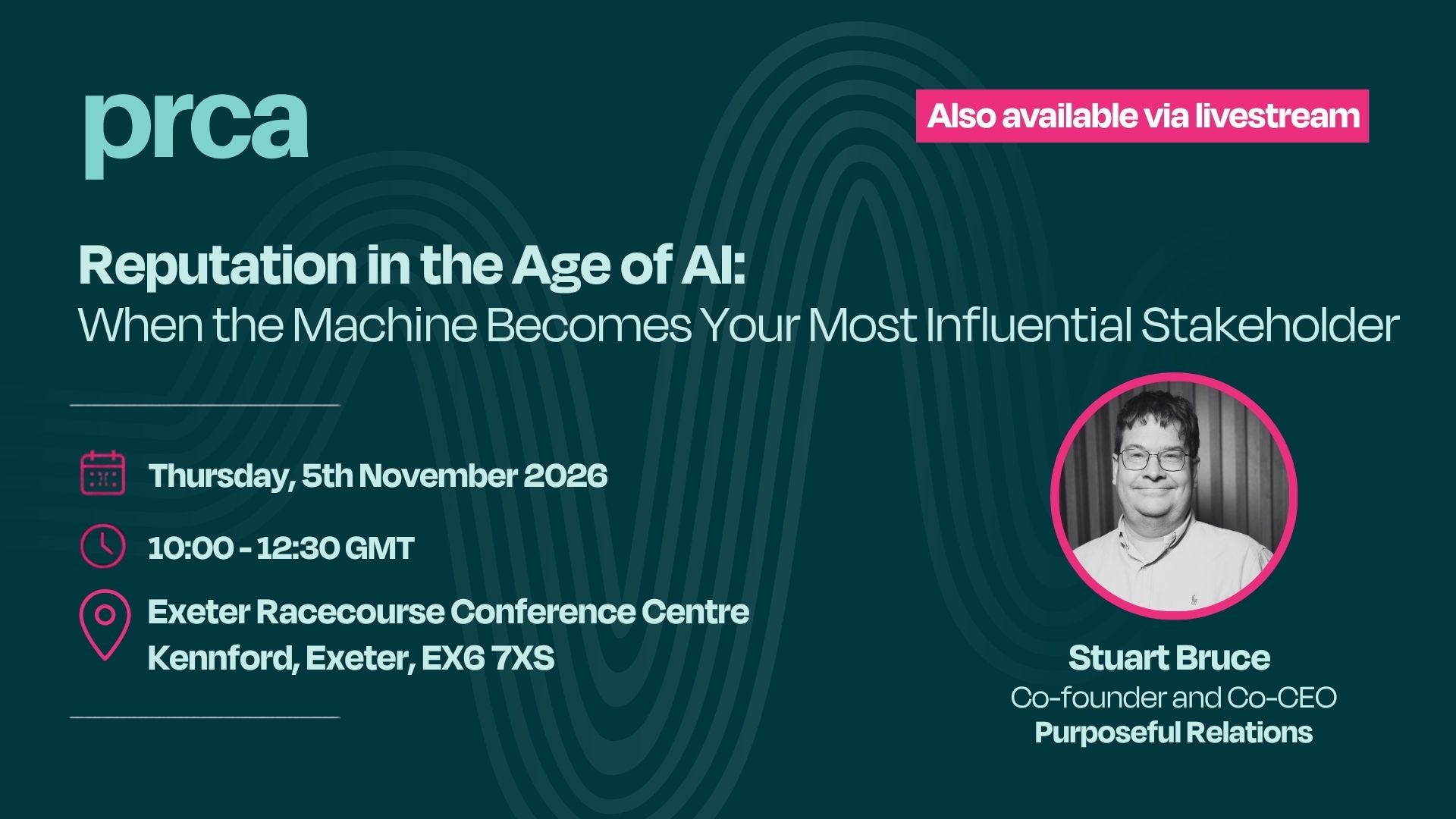
Next week I’m speaking to regional business leaders in the South West of England at a PRCA event at Exeter Racecourse. It’s an in-person event but will also be livestreamed if you can’t make it. I’ll be talking about ‘Reputation in the Age of AI: When the Machine Becomes Your Most Influential Stakeholder’. Register here.
Invite only breakfast about ‘What is AI saying about your organisation?’
On 17 November Purposeful Relations is co-hosting an invite-only breakfast for senior communications leaders to discuss ‘What is AI saying about your organisation?’. It’s in partnership with Luther Pendragon and will be held at its offices in central London, next to Monument Tube station. I’ll be speaking alongside Luther CEO Simon Maule and sharing some case studies about the reputational risks and opportunities created by AI answers. Let me know if you’d like to be considered as we have a small number of places left.
Fact checking 75,000 facts in AI answers
How accurate are AI answers about the news?
The Full Fact charity has published some important and fascinating research about the accuracy of AI answers. As more and more people use AI for news and research, Full Fact is looking at scrutinising it in the same way it scrutinises traditional mainstream media.
It’s interesting from a corporate affairs and PR perspective not just because of the results, but because of the methodology. Marketers are obsessed with crude brand visibility but from a corporate affairs perspective accuracy is often far more important. It’s an important part of the work Purposeful Relations does with clients.
The Full Fact AI Chatbots Benchmarking Report: An Independent Assessment found that the LLMs tested “gave reliable, accurate answers, and none repeated the core misinformation at the heart of some of our more sensitive civic questions.” One main weakness was presenting “outdated information as current.” Another was inconsistency where one model provided different answers on different occasions. The LLMs also make mistakes with calculation, not by getting the maths wrong, but by constructing the answer from accurate data but misinterpreting it and presenting the answer with confidence.
All of the problems identified by Full Fact are ones that we help clients to manage by treating AI as a stakeholder and doing GEO/AEO to identify and correct incorrect or misleading answers. Full Fact’s research appears to show that LLMs have an over-reliance on training data.
We’ve recently completed a project for a public sector client where we researched LLM answers to an important public safety issue and discovered many that were wrong or misleading. The primary reason was LLMs being unduly influenced by US sources that are not relevant to the UK and, in some instances, are simply wrong
Full Fact had similar findings as it found evidence that AI systems can give incorrect UK answers because they fail to recognise geographic and jurisdictional context, sometimes drawing on authoritative-looking US sources for explicitly UK questions or applying rules from one UK nation across the whole country.
Get in touch if you want us to help you understand how your organisation is showing up in AI answers and what the reputational risks are.
AI misuse is now the biggest threat to corporate reputation
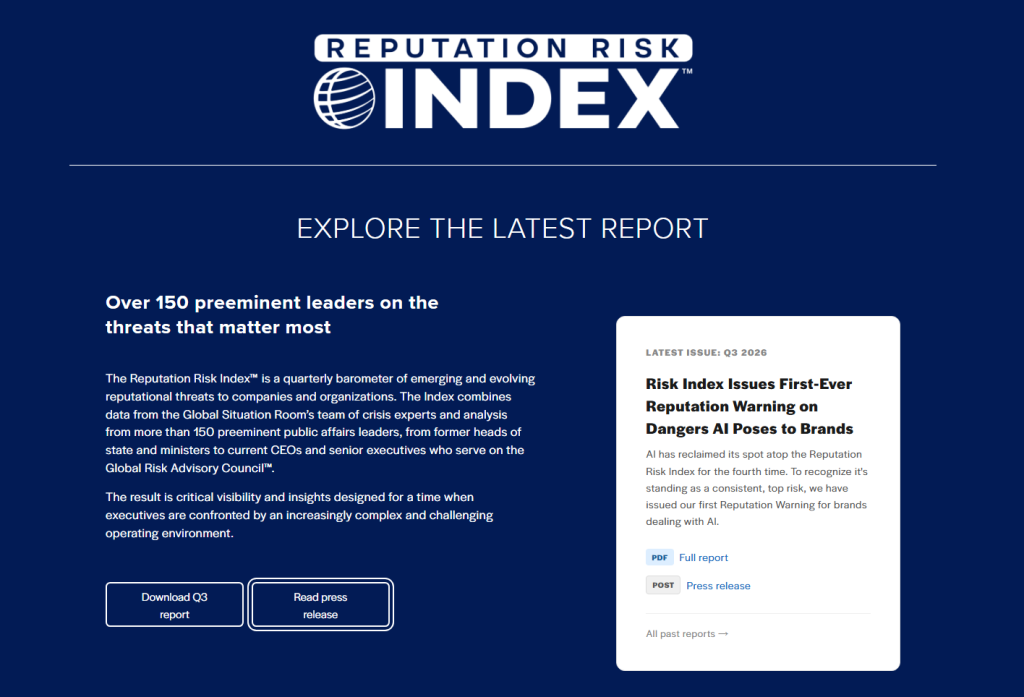
AI misuse is now the biggest threat to corporate reputation according to the latest global edition of the quarterly Reputation Risk Index from the Global Advisory Risk Council. The risk is judged to be greater than accusations that a company has exposed children to mental, emotional or physical harm (second), and the corporate issues arising from the US-Israel war with Iran.
The council advises business leaders to “take immediate and decisive action to mitigate potential long-term brand damage” warning that AI has “become a clear and present danger to public confidence for many corporations”.
The reputational risk created by AI is one of the reasons Purposeful Relations launched its AI Trust Licence advisory service. Our methodology helps organisations demonstrate that they are using AI safely, responsibly and transparently. This includes advising on where governance and behaviour need to be improved in order to earn and maintain stakeholder trust.
Read more in my in-depth article on AI misuse is now the biggest threat to corporate reputation.
US political campaigns using GEO to influence voters
I’ve been arguing for some time that UK political parties are seriously behind the curve as most think they are at the cutting edge because they’ve mastered social media.
The US mid-terms are showing how political campaigns are now using generative engine optimisation (GEO) to influence voters. The National Conference on Citizenship reports that a quarter of eligible voters have asked an AI chatbot about a political candidate to help them decide how to vote.
Reuters has obtained a PowerPoint presentation from a Republican challenger for governor of Massachusetts that sets out a strategy to convince ChatGPT, Claude, Gemini and other chatbots to present him as the preferred choice on key issues.
The core idea is that campaigns can increasingly shape the information environment by feeding AI information that influences how candidates, topics, issues and policies are described, compared and recommended.
There are enough examples of ‘bad actors’ manipulating AI answers to show UK politicians just how critical it is to tackle this now.
PRCA Leaders’ Lunch

We recently hosted a PRCA Leaders’ Lunch where we had a lively discussion about a wide range of AI issues impacting public relations and communications. The discussion looked at effective AI adoption and the challenges of managing reputation in the AI era, including the broader issue of earning and maintaining the social licence for AI.
Thanks to all the attendees from Eversheds Sutherland, Aviva, Crédit Agricole, NSPCC, Cirkle, Anchor Hanover and Marie Curie UK.
Are you ready for the “judgement economy”?
The new Ipsos Reputation Council report, “Life after Predictability”, says we are entering the “Judgement Economy” where information is abundant, content is cheap and answers are machine-generated, so human judgement becomes more valuable than ever.
It calls on senior communication leaders to shift from being “storytellers to stewards”. It argues the role is to help leaders interpret events, anticipate risks, understand stakeholders and assess the consequences of decisions for their organisations. That requires judgement, experience and analysis skills, rather than traditional content skills.
The report says data literacy, AI fluency and personal resilience are critical skills for communications leaders.
There’s much more in the “Life after Predictability” report worth digesting and considering.
How Russia is influencing AI large language models
If you still think generative engine optimisation (GEO) is just hype or just for marketing, then this report from the Global Disinformation Index is yet another wake-up call. It shows how such models are being exploited to disseminate Russian state narratives. It reminds us that in an era where zero-click searches have reached 60%, whoever influences the AI summary box on search engines, controls the narrative.
It found that when independent reporting on topics was scarce that the AI models repeated false or contested claims in more than two-thirds of their responses.
This vulnerability isn’t just about geopolitics. Any business or organisation is just as vulnerable, especially if it is in a contested, controversial or regulated sector.
Daily Mail tests GEO ahead of an AI visibility product
The Daily Mail is running 12–15 GEO tests with brands across the UK, US and Australia. It looks at which sources AI platforms cite and identifies opportunities to create branded content that could increase visibility.
In one early test, an unnamed personal finance brand reportedly went from being in around 50% of its target prompts to nearly 75%. The Mail isn’t the first publisher to try and commercialise GEO products as Future and Ziff Davis already have products and clients.
The rise in paid GEO placement from publishers raises ethical, regulatory and commercial issues as it further blurs the line between advertising (paid media) and editorial (earned media).
Did you miss the ‘Your Brand Has Entered The (AI) Chat’?

If you missed the Onclusive on the Road ‘Your Brand Has Entered The (AI) Chat’ event you can catch up by watching the video. I was on an expert panel with Claire Lamb, Darryl Sparey and Trish Dominy. It’s usually my shirts and waistcoats that attract comments but this time it was Darryl’s pineapple onesie. You’ll have to watch to find out why (or ask me!).
Now you can choose leading frontier models in Copilot
Microsoft is continuing to innovate and add powerful new features and functions to Copilot. Some of the latest include:
Use advanced frontier AI models: Microsoft is expanding access to advanced AI models across Copilot by introducing usage-based billing for GPT-6 Astra and Claude Fable 5.1 in Copilot Chat, Word, Excel and PowerPoint. The worldwide rollout starts in early November 2026 and should finish by mid-November. Availability will depend on an organisation’s billing configuration, user licensing and allocation of Copilot credits.
Copilot for multiple inboxes: Microsoft is improving how Copilot in Outlook works by enabling a unified inbox so Copilot can work with multiple email accounts, rather than just the user’s primary account. This is a significant improvement for comms teams that use media@ or clientname@ type shared in-boxes.
PRCA Census
The PRCA UK Census 2026, in partnership with MPS Evolving Insights, is open for responses. Please complete the census by Friday 6 November.
AI Signal Boost
Short snippets to keep you informed of the latest news and research impacting public relations, communications and corporate affairs.
Telegraph cuts 100 jobs to become a “global, AI-powered business”.
AI search tools cite a made-up concept within weeks.
Meltwater publishes Global Digital Report with data on social media and AI use.
Tony Blair Institute for Global Change launches CentreAI, a secure AI tool specifically for government and political leaders.